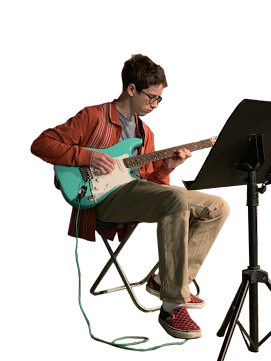

You may have experienced your child wanting to quit music and losing interest after begging you for piano or guitar lessons. (Or maybe you have experienced this personally! We meet lots of parents who quit piano lessons as kids, and always wish they hadn’t… sound familiar?) 95% of the time (based on my observations over the last 25 years), the reason a young musician quits is because of the answer to one of three questions. These are the three questions I ask every parent that comes to me with this question. We’ll examine each in more detail.
“He started out as an incredibly musical kid….”
I was inspired to write this post after I met a lovely couple at a party last weekend. We got to talking and they shared the story of their eleven year old son, Isaac, who had spent a few years taking piano lessons and eventually seemed to lose all interest and quit. Problem was, he had started out as ‘an incredibly musical kid.’ He loved to sing songs and would pick out simple melodies on the piano. By all accounts, he wanted to make music and his parents wanted to support that.
They asked me what went wrong?
What happened?!
Here are the three questions I ask every parent that comes to me with this concern.
1. Is your child SUPER PSYCHED to see his/her teacher every week?
2. Where is the ‘practice area’ in your home?
3. Does mom, dad, or siblings play with him/her?
95% of the time (based on my observations over the last 25 years), the reason a musician like Isaac quits is because of the answer to one of these three questions. Let’s examine each in more detail.
Question #1:
Is your child SUPER PSYCHED to see his/her teacher every week?
Does your child love his or her teacher? Music is a social art form meaning that it is intended to be shared. It’s a language and languages are most fun when used to communicate. And the first thing you need in order to start communicating (or even attempting to communicate) is the courage to do so. Courage comes from trusting the world around you. And for Isaac, his music world was defined by his teacher.
He needed to build a relationship of trust with that person. That was step number #1. Pure and simple.
Successful teachers do everything that great communicators are known for:
- They ask lots of questions.
- They listen more than they talk.
- They have a genuine interest in discovering the story of their students.
Students respond by wanting to connect with their teacher. They want to come back each week and tell them (& show them) what they discovered. They want to share their successes and their failures in music.
So, step #1 for any successful music student is to be super psyched to see their teacher every single week.
If your child is anything less than super psyched, I’d ask yourself if you have the right teacher. Every teacher must have a clear mission for your child and a well-defined curriculum to back it up (that needs to be a basic starting point… a given)…BUT they also must be rock solid communicators. They need to be someone your child genuinely trusts and is psyched to be alone in a room with for 45 minutes every week.
Question #2:
Where is the ‘practice area’ in your home?
Is your practice area somewhere behind a closed-door? Somewhere far away from everyone else? Is it down in the basement? Is it in a bedroom? Is it lonely?
If so, you are in trouble!
This is the most common rookie mistake made by parents of new music students.
Your child wants to be part of the home. They want to do their home work close by. They want to sit and read with you in eye sight. And guess what, they also want to explore music within ear shot of you.
Music is NOT practice at the early stages of learning (think first 1-4 years of lessons). It is playing and exploring and discovering.
Create a play space with the keyboard and guitar and some miscellaneous percussion and make it as close to the center of activity in your home as possible. Mine is three feet from our kitchen. My children play piano and sing while I cook. Neither one of us ever feels left out. (Check out Part 2 of Making Practice Work – Where to Practice – for more insight on this!)
Question #3:
Does mom, dad, or siblings play with him/her?
And this brings us to the final question, the one where parents put up the most resistance. The irony is that this is, in fact, one of the greatest joys of your child’s musical journey, it opens up a whole new way for the two of you to communicate. It’s a new way to deepen your relationship with one of the most important people in your life.
Playing music with your child is THE most effective tool we have ever seen used to motivate and inspire exploration and commitment. It’s so simple yet so often overlooked.
The resistance from parents always comes in one of two comments:
- I am NOT a musician. In fact, I’m tone-deaf! I don’t even understand what my child is working on. I can’t read music. How can I play along???
- I’m too busy. Music is their thing. They practice on their own. He doesn’t want me involved…
Sound familiar?
Let’s be clear about something here… you either invest in your child and their launch into a life of music or you don’t. And spending money and buying an instrument is the easy part. The hard part of parenting is taking risks and taking the next step: building in a new habit of jamming with your child or doing something musical together regularly.
Everyone is a musician, including you
Absolutely everybody is a musician of some kind and that includes you. Your child does not need you to sing beautifully or be an incredible guitarist to join them in a jam session. You literally just need to clap along or hum along or play a hand drum… you can even whistle!
And you need to stop whatever else you are doing for five minutes and just jam. No strings attached. No judgement. It’s NOT practice (even though it is…). Just make music with your child. Make a habit of this and your child’s chance of success (meaning they continue to make music for the rest of their life) quadruples.
One of my favorite parts of parenting was reading aloud and along with my two daughters. We had stacks of books by their bed and sitting with them for an hour and exploring a new book was often the highlight of my day. They no longer ask me to read to them and I have to ask if I can sit with them and read my book. They are now 14 & 16. It would make me sad except that both of them love to read and devour books on their own. They will read and find joy in books for the rest of their life. I am now confident of that.
The opening chapters of your child’s musical life are like reading aloud, it’s an adventure you go on together.
Which path will you take?
So please, ask yourself those three questions and give an honest assessment of the answers. Because otherwise, your child may be at risk of following the path of Isaac. And as parents, we like to know if and when we are making choices about our child’s future.
And by the way… It’s never to late to try and fire up that musical spark again, it just takes more energy on your part as your child gets older and (funny to write this!) more set in their ways.
Here is hoping that Isaac & family find another musical spark!
-Nate Shaw, co-founder of Brooklyn Music Factory
P.S. We’ve put together this Musical Family Toolkit to help parents everywhere start their family’s music lesson journey in the best way possible, based on the lessons we’ve learned here at Brooklyn Music Factory working with thousands of families. Download it today!