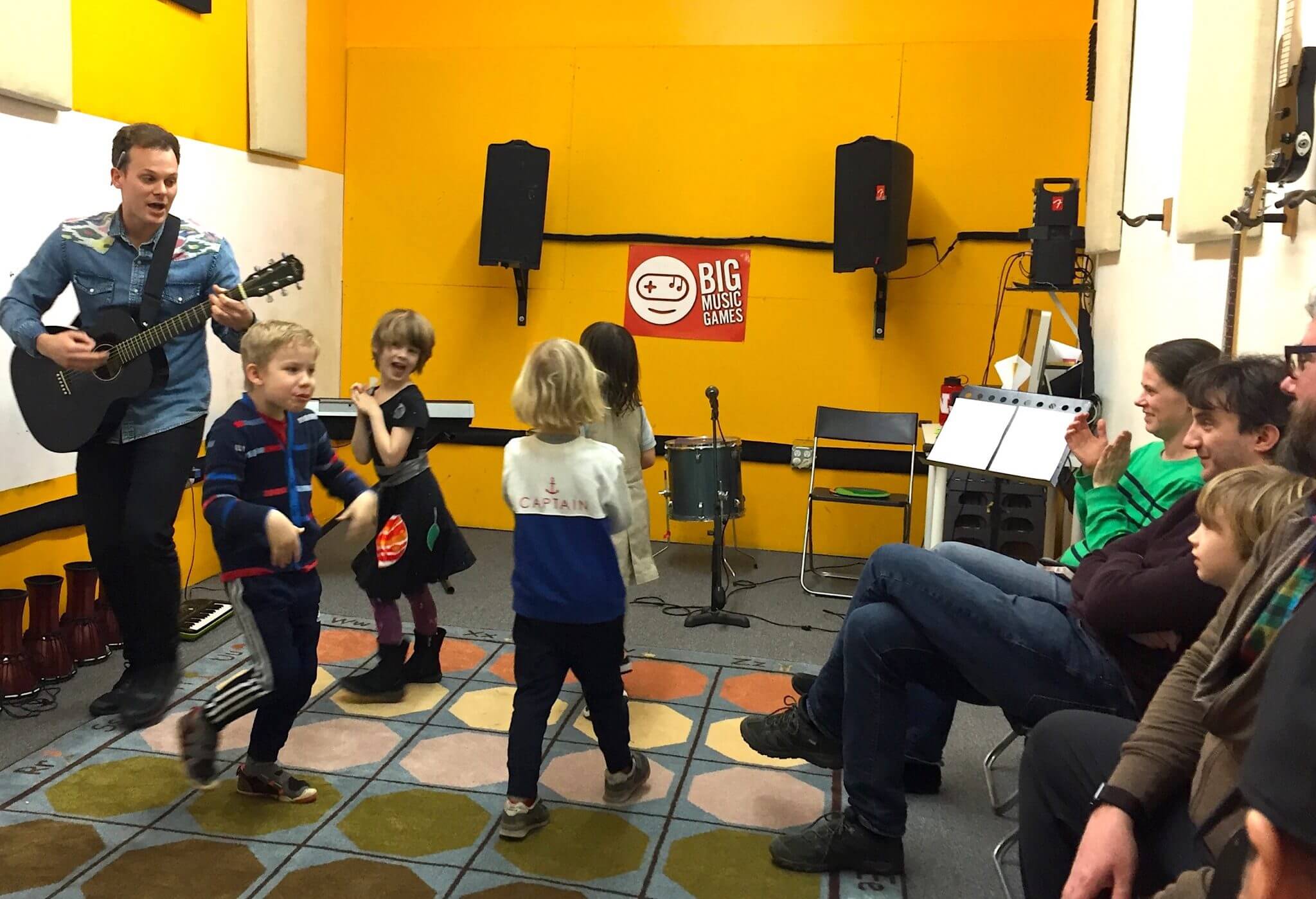
At Brooklyn Music Factory, we believe in a “Fun First” approach. We have seen that when kids are having fun, they build confidence and musical skills much faster. This is why we created Big Music Games (or BLAM Games—Big Lesson About Music).
These games are woven into every single lesson and class, regardless of which instrument a student is playing. They are designed to teach the fluency of musicianship through ear training and music theory.
Here is how we break down our music games:
1. Melody Games
We use an “Ear Before Eye” approach. Before a student looks at a sheet of music, we want them to hear the music in their head.
-
Featured Game: Wait A Second! In this game, students listen to the distance between two notes (intervals). By training their ears to recognize these distances, they can eventually hear a melody on the radio and immediately know how to play it on their piano, guitar, or drums.
2. Harmony Games
Harmony is all about how chords support a melody.
-
The Goal: Students start by playing games that ask them to listen for a single “chord quality.” Is the chord “happy” (Major) or “sad” (Minor)?
-
Leveling Up: As they progress, the games challenge them to hear harmonic rhythms—recognizing when one chord moves to another and another. This helps students understand why they are learning so many chords on their instrument.
3. Rhythm Games
Rhythm is the heartbeat of music. Our rhythm games focus on internalizing the “Big Beat.”
-
Featured Game: Groove Puzzler Students listen to a rhythm and then have to “solve the puzzle” by placing note values (quarter notes, eighth notes, etc.) in the correct order to match what they heard. This turns “counting” into a fun, tactile challenge.
4. Songwriting Games
Songwriting gives kids ownership over their music. It’s not just something they play from a book; it’s something they created.
-
Featured Game: Word Beat This game teaches prosody—the way words fit into a rhythm. We might take a simple sentence and challenge the student to fit it into a 4/4 measure. It teaches them how to align syllables with beats, which is the foundation of writing lyrics.
Why do we play these games?
-
To measure growth: Instead of stressful tests, we use “Leveling Up” in games to see how a student’s ears are getting stronger.
-
To build community: Games are social. Whether online or in our Brooklyn studio, kids play these games together, building communication skills alongside music skills.
-
To hear MORE: When a student plays these games, they start to listen more actively. They don’t just hear a song; they hear the patterns, the shifts in harmony, and the groove.