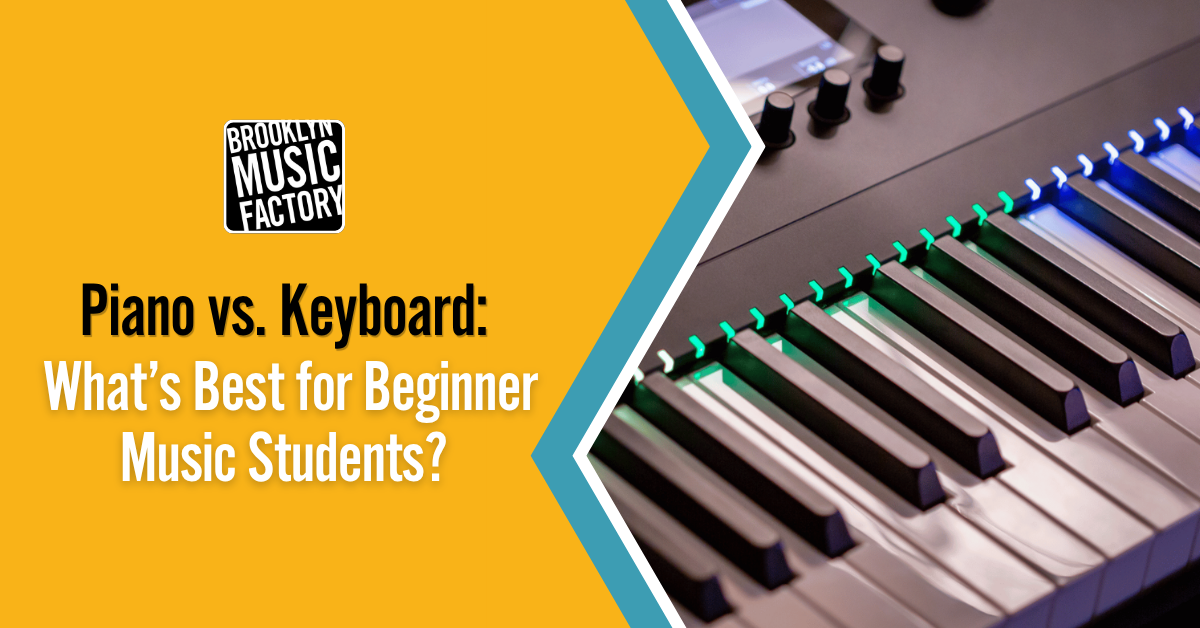
Choosing between a piano vs keyboard for beginners is one of the first big decisions parents make when their child shows interest in music.
And it can feel like a loaded one.
Do you go traditional?
Do you go practical?
Are you setting them up the “right” way?
The truth is: both options can lead to great outcomes.
What matters most isn’t the instrument—it’s whether your child actually wants to sit down and play.
At Brooklyn Music Factory, we’ve worked with kids starting on everything from full acoustic pianos to small keyboards in tight Brooklyn apartments. And we’ve seen one thing over and over:
The best instrument is the one that fits your life—and keeps your child engaged.
Let’s break it down so you can make the right call for your family.
Understanding the Basics of Piano and Keyboard
At a glance, they look the same.
Black keys, white keys, same layout.
But they feel very different to play.
Differences in Touch, Feel, and Sound
An acoustic piano is fully mechanical.
When you press a key, a hammer hits a string. You feel resistance, weight, and subtle control over how the note sounds.
A keyboard is digital.
Instead of strings, it triggers recorded sounds. Depending on the model, the keys can feel light and springy—or closer to a real piano.
Here’s the key distinction:
- Weighted keys (found on higher-end keyboards) mimic the feel of a piano
- Unweighted keys (common on beginner keyboards) are lighter and easier to press
For younger kids, lighter keys can feel more accessible. For older beginners, weighted keys help build better technique over time.
Number of Keys and Portability
A full piano has 88 keys.
Keyboards can have 61, 76, or 88.
For many Brooklyn families, space matters. A smaller keyboard can easily fit into a bedroom or shared space—while a full piano is a long-term commitment.
Benefits of Learning on a Piano
There’s a reason acoustic pianos are still considered the gold standard.
They build strong fundamentals.
Developing Finger Strength and Control
Because piano keys require more effort to press, kids naturally build strength and control in their hands.
This helps with:
- Finger independence
- Tone control
- Long-term technique
Rich Sound and Expression
A real piano responds to how you play.
Soft touch, loud dynamics, subtle differences—it all comes through.
For kids who love expressive playing or classical music, that feedback is powerful.
Benefits of Learning on a Keyboard
Keyboards aren’t just a “lighter version” of a piano.
For many kids, they’re actually more engaging.
Practical, Flexible, and Affordable
Keyboards are:
- Easier to move
- More affordable
- Apartment-friendly (especially with headphones)
That makes them a great starting point for families who aren’t ready to commit to a full piano.
Built for Creativity and Exploration
This is where keyboards really shine.
Many come with:
- Different instrument sounds
- Built-in beats
- Recording features
For kids interested in songwriting for kids, this can be a huge hook.
They’re not just playing notes.
They’re experimenting, producing, and creating.
How Music Fluency Supports Beginner Students
At Brooklyn Music Factory, we focus on something bigger than the instrument: music fluency for beginners.
That means building skills in:
- Rhythm
- Melody
- Harmony
- Songwriting
And the important part?
You can learn all of that on either a piano or a keyboard.
Teaching Fluency on Both Instruments
Both instruments use the same layout.
So kids can:
- Learn chords the same way
- Understand patterns the same way
- Write songs the same way
A child who understands music can switch between instruments easily.
That’s why we focus on how music works, not just what keys to press.
Choosing the Right Instrument for Your Child
So how do you decide?
It usually comes down to four things.
Age and Physical Readiness
Younger kids (ages 4–6) often do well with lighter keys.
Older kids can benefit from the resistance of weighted keys.
Your Home Setup
Let’s be honest—space is real.
If a full piano doesn’t fit your home (or your neighbors’ tolerance), a keyboard with headphones can be a lifesaver.
Your Child’s Personality
This matters more than anything.
- Kids who love exploring sounds and experimenting often thrive on keyboards
- Kids who are drawn to performance and expressive playing may love a piano
Your Learning Environment
Many modern programs—including ours—are flexible.
At Brooklyn Music Factory, our piano lessons in Brooklyn work with both instruments, especially in the early stages.
Real-Life Recommendations
If you’re still unsure, here’s a simple way to think about it.
Choose a Piano If:
- You have the space and long-term commitment
- Your child is drawn to classical or expressive playing
- You want a permanent instrument in your home
Choose a Keyboard If:
- You’re working with limited space
- You want a lower-cost starting point
- Your child is excited about modern music, sounds, or production
The Middle Ground (Best for Most Families)
A high-quality 88-key weighted keyboard.
You get:
- The feel of a piano
- The flexibility of a keyboard
- A practical fit for city living
This is the most common starting point we recommend.
What Parents Notice
Parents often worry about choosing the “right” instrument.
But what actually matters shows up quickly.
When kids are engaged, they:
- Sit down and play without being asked
- Start experimenting on their own
- Feel proud of what they’re making
We hear it all the time—kids who start exploring, writing little ideas, and building confidence within weeks.
That’s the real goal.
Conclusion
Choosing between a piano vs keyboard for beginners doesn’t have to be stressful.
Both can lead to strong musical skills.
Both can support creativity.
The best choice is the one your child will actually use.
Because at the end of the day, we’re not teaching the instrument.
We’re teaching the child.
If your child feels excited to sit down and play, you’ve made the right call.
Ready to get started? Explore our piano lessons in Brooklyn and see how we help beginners turn their first notes into real music.
FAQ
What is better for beginners: piano or keyboard?
Both can work well. The best choice depends on your space, budget, and your child’s interests.
What age should a child start on piano vs keyboard?
Many kids start exploring keyboards around age 4, while piano technique often develops more easily around ages 6–7.
Do kids learn faster on a keyboard?
Early progress can feel faster on a keyboard because the keys are easier to press, but long-term technique benefits from weighted keys.
Are kids’ piano classes in Brooklyn designed for one instrument?
Most modern programs are flexible and focus on musical skills that transfer across both instruments.
Can my child take lessons if we only have a keyboard?
Absolutely. Especially in the early years, a keyboard is more than enough to build strong musical foundations.